

01 A Billion-Yuan Market Held Hostage by “Tradition”
At first glance, many people might assume that with fewer young people getting married, the wedding market is no longer worth playing in. But the truth is, this often-overlooked market is still worth nearly RMB 100 billion a year. On the surface, the wedding transportation business appears to have long been divided up among rental companies and wedding agencies. Yet beneath that surface lies a striking contradiction: more than 80% of newlyweds complain that wedding cars are the most uncontrollable part of the entire wedding. Last-minute price hikes, vehicle failures, and even drivers showing up in slippers to pick up the bride are not rare. These absurd cases expose a dual absence of industry standardization and professional service. StarRides’ ambition to disrupt the wedding car market is not simply about adding another product line. At its core, it is about elevating transportation into a certainty-based experience and using standardized processes to rebuild a chaotic wedding car ecosystem. The ultimate goal of this transformation is simple: to make every wedding car a guardian of the couple’s happiest moment, rather than a hidden risk.02 The Ambition Behind One Manual: Build the Brand Externally, Control the Details Internally
StarRides’ request was unusually clear: “We need a weapon—something that can communicate our value externally and make couples instantly feel drawn to us, while also being executable internally so that rental company owners and drivers know exactly what to do.” That made the project’s core objectives immediately clear:- A product menu: break the service down into “base packages + add-on options,” as easy to understand as ordering at Starbucks
- An execution guide: specify everything in the SOP, from what time the driver should clean the car, to how to handle encountering a funeral procession, to how to fix wind-blown floral decorations
- A marketing tool: something rental company owners can use to pitch clients, and that couples can flip through for just two pages and immediately understand why to choose you
03 Breaking Down the “Old Demand” to Find New Answers
Why is it that traditional wedding car services are becoming less and less convincing for younger consumers? Twenty years ago, even a Santana used as the lead wedding car would be covered in plastic flowers. Twenty years later, even a Rolls-Royce stuck in traffic on the Bund becomes just another backdrop. When luxury cars become easier to book than shared bikes, today’s young consumers begin to turn wedding transportation into a kind of identity split on wheels. Take away the sentimental veneer, and wedding cars have already become a magnifying glass for human nature. In fact, 76% of newlyweds say wedding cars are basically just a “premium version of a freight van.” The wedding transportation market may look mature, but in reality it is trapped in contradictions:- Fragmented service: drivers’ etiquette varies wildly, and red-envelope tipping has become an unspoken rule
- Fragmented experience: promised vehicle models are often not delivered, and there are no contingency plans for emergencies
- Fragmented value: couples want ceremony and emotional meaning, while the industry still offers little more than transportation tools
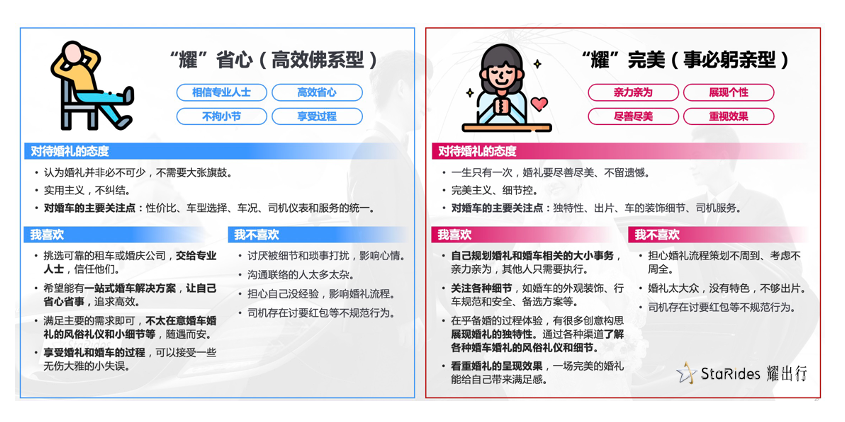 The easygoing camp wants peace of mind.
The detail obsessives are betting on a sense of ceremony.
StarRides’ breakthrough was to identify the greatest common denominator between them:
Promise zero surprises to everyone: lock in wedding fleets a week in advance even for peak dates, make overtime fees fully transparent, and even keep spare tire bolts on hand
Preserve room for the detail-oriented: car badges engraved with the couple’s initials, an emergency kit in the bridal car, celebratory confetti at the moment of arrival, and more
StarRides’ three core value propositions all came directly from the pain points of these two representative user groups:
The easygoing camp wants peace of mind.
The detail obsessives are betting on a sense of ceremony.
StarRides’ breakthrough was to identify the greatest common denominator between them:
Promise zero surprises to everyone: lock in wedding fleets a week in advance even for peak dates, make overtime fees fully transparent, and even keep spare tire bolts on hand
Preserve room for the detail-oriented: car badges engraved with the couple’s initials, an emergency kit in the bridal car, celebratory confetti at the moment of arrival, and more
StarRides’ three core value propositions all came directly from the pain points of these two representative user groups:
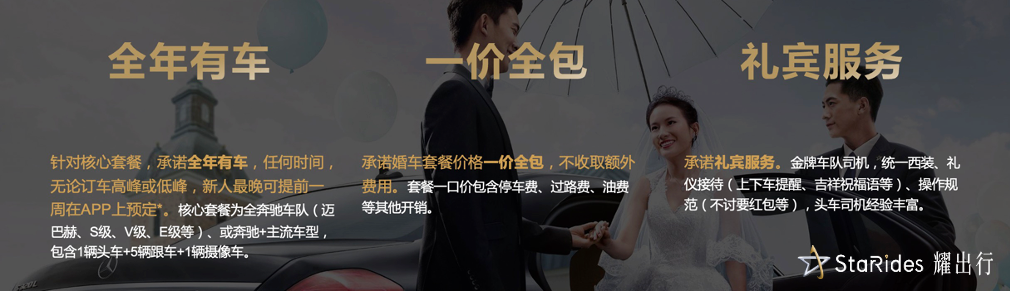
- Cars available all year round: in response to the anxiety of not being able to secure cars on popular wedding dates, StarRides promises that even one week in advance, customers can still lock in a Mercedes fleet
- One fixed price, all inclusive: in response to the trust crisis around hidden fees, everything from parking fees to fuel costs—even rules for overtime charges—is made transparent
- Chauffeur-style service: in response to the industry-wide problem of drivers asking for red envelopes, professionalism is rebuilt through suits, white gloves, and standardized service language
04 A Sharp Methodology for Winning in Niche Markets
Good service cannot rely on promises alone. It has to be delivered at the front line. To achieve the goal that every wedding car becomes a guardian of happiness, StarRides built a complete service system grounded in real scenarios—one that is executable, perceptible, and reusable. Starting with a standardized service handbook, the project upgraded wedding transportation from a rental logic to a concierge logic: Time granularity: not just full-day service, but the lead car arriving one hour early to check tire pressure Action granularity: the driver does not simply say “please step out,” but raises a hand to protect the passenger from hitting the door frame Emotional granularity: when encountering another wedding convoy, drivers exchange wedding candy; when passing a hospital, soft music is playedThe Silent Sixth Car
During user interviews, one small story left a deep impression.
A Shanghai user, whom we will call Zhang San, rode in a Lamborghini lead car that drew everyone’s attention on the street. But nobody noticed what was happening in the accompanying vehicles: the air conditioning in the fifth Audi A6 had broken down, forcing the bridesmaids to roll down the windows throughout the journey in 35-degree heat.
This story exposed one of the industry’s most common blind spots: all attention goes to the lead car, while the following cars are neglected.
That is why one of the most innovative service breakthroughs in the StarRides project was to bring the sixth car into the service standard.
All accompanying cars were included in a unified inspection checklist, with measurable indicators covering everything from air-conditioning vent cleanliness to tire wear thresholds.
The team also introduced a Happy Ride service for accompanying vehicles: curated wedding playlists preloaded in the car, customized props for filming and photos, and other touches that transformed the previously invisible follow cars into an active part of the experience loop.
05 Leave the Complexity to Us, Keep Execution Simple for the Front Line
In the StarRides service upgrade project, we focused on two core goals: To do this, we built a standardized operational system covering the full process, including: service-step breakdowns across 19 customer touchpoints standardized response scripts for 7 high-frequency scenarios This ensured that every step had a clear standard to follow. At the same time, considering the real needs of driver groups, we innovatively condensed the core service standards into a one-page battle card. With modular visual layouts and mobile-friendly design, drivers could locate the guidance they needed within three seconds, making the system genuinely easy to use: no training required, memorable at a glance.After launch:
driver adoption of the new tool remained above 92% service response speed improved by 40%

06 A Model Example of China Bridge’s “New Service Experience” Practice
StarRides’ breakthrough in the wedding transportation market is a vivid example of the value of China Bridge’s New Service Experience offering. Faced with a niche market that appeared to be fully divided up but was actually full of hidden tension and opportunity, StarRides partnered with China Bridge to explore and put into practice the real business meaning of experience elevation. The core of marketing is not price competition. It is creating an experience worth sharing. China Bridge’s New Service Experience methodology is designed to help companies decode user demand scenarios at a deeper level. By designing innovative service processes and experience details, it builds emotional bridges between businesses and users, enabling a deeper emotional symbiosis between both sides.Every Industry Deserves to Be Rebuilt Under a Microscope
Beyond StarRides, where else can this methodology be applied? Take the health check industry, for example. Today, most health check packages differ only in price and item lists—but do they actually differ in experience? If we examined the industry under a microscope, what should distinguish a customized executive health check package from a standard pre-employment medical exam? The answer is not simply “more premium items.” It should extend from the wording used at the appointment stage (“Your dedicated advisor is available 24/7”), to the circulation flow during the check-up (avoiding contact with general users), to the ritual of report interpretation (a one-on-one private consultation). Every touchpoint requires manual-level standardization. What about other industries? Chain tea brands? Postpartum care centers? And beyond? The real opportunity is hidden in the details that users have grown used to settling for. Whoever can turn “good enough” into “exactly right” is the one who can tear open a gap in the market. In a saturated market, that may be the sharpest breakthrough path of all. So take a look at your own industry: If you were to rebuild it under a microscope, what would you change?▼
