

- ‘Customer-centricity’ evolved from a slogan into a systemized methodology applicable to everyone.
- Service innovation transitioned from top-down passive execution to bottom-up proactive creativity.
- We finally discovered a way to break down silos and collaborate more effectively.”**
— Wan Weining, General Manager, Seazen Xinyi Hui
In a market increasingly dominated by homogeneous competition, more companies aim to differentiate by offering value-added services. However, adding services inevitably raises costs. Revenue from one-time product sales can no longer cover these rising costs. As a result, transitioning to a service-oriented business model that enhances customer loyalty and turns one-time purchases into lifetime value has become a critical mission for many enterprises.


01 Transformation Begins with a Unified Language
- Who exactly are our customers? Are they only senior citizens?
- We excel at building and selling houses, but without selling real estate, what services can we provide?
- How can we quickly transition our real-estate-focused teams to embrace service-oriented business models?
Xinyi Hui sought and tested various service-oriented partners. In early 2021, they discovered service design and approached CBi China Bridge, a leading firm in the field.
Service design, an emerging discipline originating in Europe, arose in response to the service economy. CBi introduced it to China in 2010 and spent over a decade localizing it, creating their proprietary CBI process.
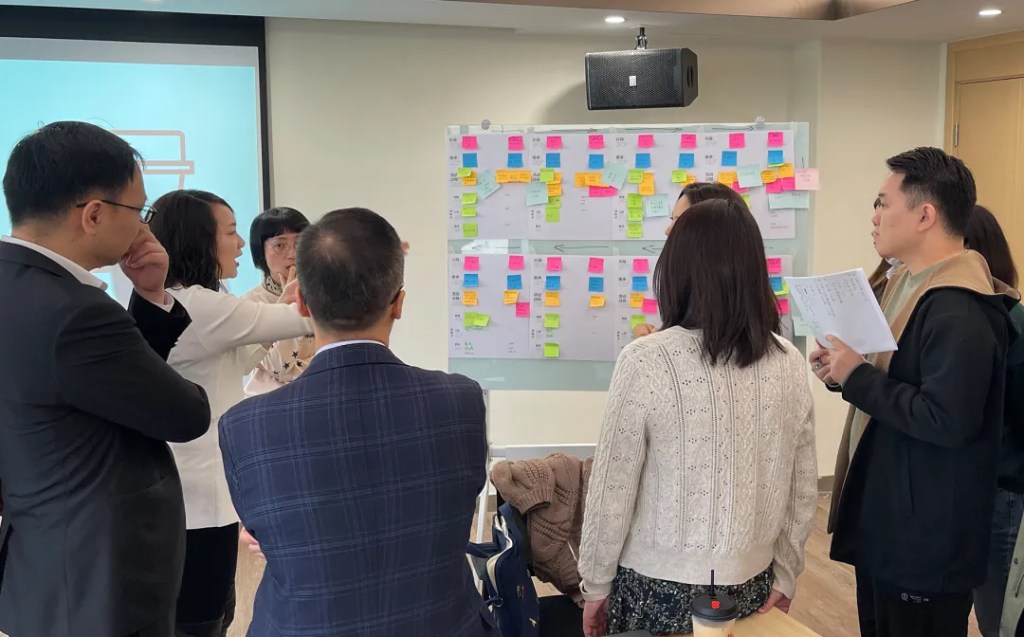
- “Service is not just about attitude; it’s about process and systems.”
- “We used to solve problems in isolation, but service design connects the dots into a cohesive system.”
- “We were focused on selling our product, but what customers need is for us to meet their needs.”
- “Our organizational restructuring efforts should start with front-end customer experiences.”
- “The greatest achievement was unifying our organizational language: ‘customer-centricity,’ and aligning on our core weapon: service design.”
02 From Training to Coaching: Guided Co-Creation from 0 to 1
After learning this new methodology, the seeds of service design began to grow within the team tasked with pioneering this new business. They were eager to apply what they had learned but encountered challenges transitioning from theory to practical application.
CBi partner Sissi, acting as a mentor, deeply engaged in Xinyi Hui’s project over the next year. With over a decade of industry experience and expertise in service design, she guided the team through cross-departmental co-creation and problem-solving while providing ongoing support:
- Identifying potential customer needs and designing an end-to-end service journey.
- Crafting a unique brand value proposition and using touchpoint design to make it tangible to customers.
- Conducting small-scale customer tests to quickly iterate on products and services, minimizing market launch risks.
- Building a “customer-centric” culture and capabilities, beginning organizational transformation with business transformation.
- Redesigning front, middle, and back-office structures from the customer’s perspective to enhance cross-departmental collaboration.
 This approach, called “guided co-creation,” transcends traditional training and consulting. It demands more from mentors, requiring not only theoretical knowledge but also extensive project experience and the ability to lead and empower teams. As Sissi put it:
“Guided co-creation is indeed challenging. It’s not about doing it yourself or telling them what to do but teaching them how to do it.”

03Redefining Business Models and Revitalizing Organizations
01. New Concepts, New Customers, New Propositions

02. New Organization, New Culture, New Systems
- Reorganizing teams based on customer segments, crossing traditional functional and hierarchical boundaries.
- Establishing a customer-centric culture where employees share customer stories during weekly meetings.
- Implementing a reward system to recognize employees excelling in service design applications.


